
SIF vs Other Metrics
Reflectance-based indices such as NDVI, NDRE and GNDVI are well established and widely used in precision agriculture for stress mapping, nitrogen management and yield forecasting. They are useful tools, and SIF is not a replacement for them. But they provide a different type of information. Reflectance indices infer plant status from how the canopy looks. SIF, by contrast, originates directly from the plant's metabolism. It is emitted during photosynthesis itself, which means it responds in real time to stress events, before structural changes such as loss of greenness or reduced biomass become visible to reflectance indices.
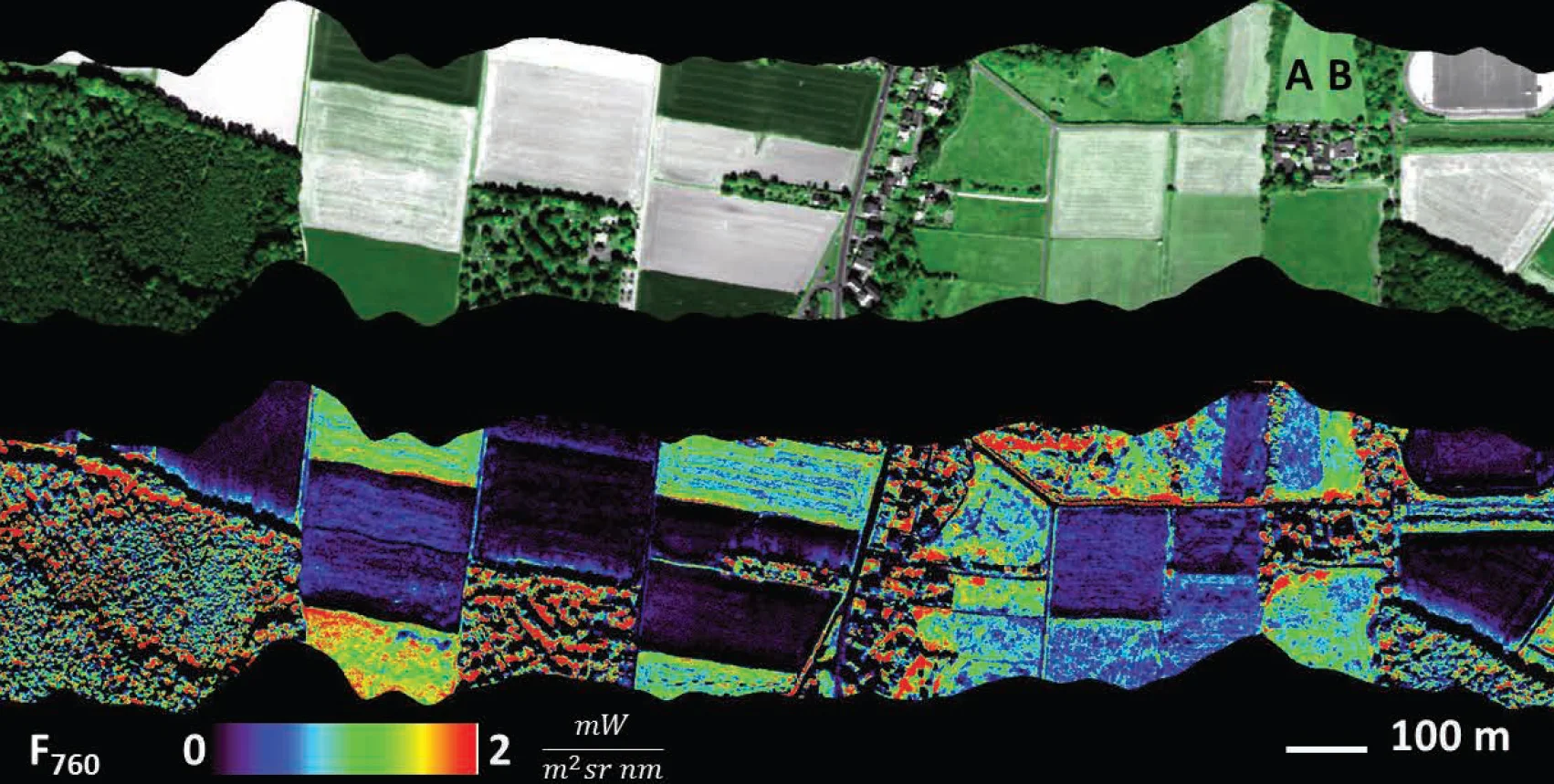
Different metrics, different questions
Vegetation indices are built from the contrast between reflectance in different wavelength bands [1][2]. NDVI compares near-infrared and red reflectance, and rises with leaf area and chlorophyll content. NDRE and GNDVI extend the same idea to the red-edge and green bands, improving sensitivity to nitrogen and water status. All of them are reflectance-based, which means they describe the structure and pigment content of a canopy. These reflectance patterns can then be used to indirectly estimate plant traits such as nitrogen content, water status, or photosynthetic capacity [1][6].
SIF is not an index from which traits are derived indirectly. It is a direct measurement of the plant's metabolism in real time and therefore a trait in itself. It scales with the rate at which photons are actually being processed by the photosynthetic machinery, so it reports actual photosynthesis rather than potential [4][5]. A canopy can show an unchanged NDVI while its SIF has already fallen sharply. That fall is the signal of a physiological problem that has not yet caused any structural change.
The figure above makes this difference concrete. In an airborne campaign over an agricultural research site at Klein Altendorf in Germany, the two neighbouring fields labelled A and B show almost identical reflectance, yet their fluorescence emission is clearly different [3][7]. To a reflectance index the two fields look the same. Their photosynthesis is not.
A comparison of metrics
The decisive difference between these metrics is lag time. A reflectance index can only change once the canopy itself has changed: the plant has to lose chlorophyll, shed leaf area or alter its structure before NDVI, NDRE or GNDVI register anything, and that takes time. SIF, generated by the photosynthetic reactions themselves, changes the moment those reactions slow down [8]. The table below summarises this difference.
| Metric | What it measures | Common use | Lag behind physiological change |
|---|---|---|---|
| SIF | Active photosynthesis, via emitted chlorophyll fluorescence | Photosynthetic rate, gross primary productivity (GPP), early detection of water, temperature, biotic, and nitrogen stress | None, measured in real time |
| Surface Temperature | Canopy thermal emission | Water stress, transpiration | Minutes to hours; faster than reflectance indices, slower than SIF |
| NDVI | Near-infrared (NIR) vs red reflectance contrast | Biomass, leaf area, canopy cover, and general vigor | Days to years, depending on plant and stressor |
| NDRE | NIR vs red-edge reflectance contrast | Chlorophyll content, nitrogen status, sensitive in dense canopies where NDVI saturates | Days to years, depending on plant and stressor |
| GNDVI | NIR vs green reflectance contrast | Chlorophyll content, nitrogen and water status | Days to years, depending on plant and stressor |
| RGB | Visible appearance | Visual scoring, structural damage, late-stage disease and pest symptoms | Days to years, typically a little behind indices like NDVI |
Why response time matters
The advantage of a real-time signal is clearest under stress. In a controlled drought experiment, SIF began to change before canopy surface temperature did, and surface temperature is itself a fast-responding stress proxy that precedes any visible change in reflectance [8]. SIF is therefore the earliest passive optical indicator of physiological decline that is currently available.
This is not limited to drought. A meta-analysis of steady-state chlorophyll fluorescence found measurable responses to water, temperature and nitrogen stress, although the sensitivity differs by stressor [9]. During heat waves, SIF has been shown to track gross primary productivity in real time, capturing thermal stress as it happens [10].
There is an important honesty caveat here. Under severe heat-wave conditions, the normally tight, near-linear relationship between SIF and gross primary production can break down [11]. SIF is a powerful early indicator, but it should not be presented as a perfectly linear stand-in for productivity under every extreme condition.
Saturation and the light-use-efficiency trap
Reflectance indices have a second, well-known limitation. In dense forests and well-developed crop canopies, NDVI saturates: once the canopy is full, adding more leaf area produces almost no further change in the index. The metric flatlines exactly when the canopy is most productive.
SIF does not saturate in the same way, because each additional active leaf contributes additional emission. Across seasons and ecosystems, SIF has been shown to track gross primary productivity more closely than greenness indicators [12]. In a winter wheat canopy observed across a full growing season with a tower-based spectrometer, far-red SIF at 760 nm explained 83 percent of the variance in daily gross primary production, rising to 93 percent under clear-sky conditions, while NDVI saturated early in the season and failed to follow canopy dynamics through grain filling [13].
Reflectance-based estimates of productivity carry a further weakness. They depend on light-use efficiency, the rate at which absorbed light is converted into biomass, and early models treated this rate as a constant. It is now well established that temperature and water stress change light-use efficiency substantially [3], so any method that assumes it is fixed will misjudge a stressed canopy. SIF sidesteps the assumption, because it measures the photosynthetic signal directly [4].
Complementary, not competing
The most informative monitoring systems combine both kinds of measurement. Reflectance indices map where vegetation is and how much of it there is. SIF reports how that vegetation is performing. Used together, they separate structural change from functional change.
A practical example: a field with uniform NDVI but spatially variable SIF reveals physiological differences that are not yet visible, such as patches under early water stress, nutrient imbalance or developing disease pressure [14]. Acting on the SIF signal, before NDVI responds, is the window in which an intervention is still effective [15]. SIFcam is designed to integrate with standard multispectral workflows, so SIF and reflectance indices can be collected and analysed side by side, each contributing what the other cannot.
- 1.Xue, J., & Su, B. (2017). Significant Remote Sensing Vegetation Indices: A Review of Developments and Applications. Journal of Sensors, 2017, 1353691. https://doi.org/10.1155/2017/1353691
- 2.Bannari, A., Morin, D., Bonn, F., & Huete, A. R. (1995). A review of vegetation indices. Remote Sensing Reviews, 13(1–2), 95–120. https://doi.org/10.1080/02757259509532298
- 3.ESA (2015). Report for Mission Selection: FLEX. ESA SP-1330/2, European Space Agency, Noordwijk, The Netherlands.
- 4.Mohammed, G. H., Colombo, R., Middleton, E. M., Rascher, U., van der Tol, C., Nedbal, L., et al. (2019). Remote sensing of solar-induced chlorophyll fluorescence (SIF) in vegetation: 50 years of progress. Remote Sensing of Environment, 231, 111177. https://doi.org/10.1016/j.rse.2019.04.030
- 5.Porcar-Castell, A., Tyystjärvi, E., Atherton, J., van der Tol, C., Flexas, J., Pfündel, E. E., et al. (2014). Linking chlorophyll a fluorescence to photosynthesis for remote sensing applications: mechanisms and challenges. Journal of Experimental Botany, 65(15), 4065–4095. https://doi.org/10.1093/jxb/eru191
- 6.Verrelst, J., Malenovský, Z., Van der Tol, C., Camps-Valls, G., Gastellu-Etchegorry, J.-P., Lewis, P., et al. (2019). Quantifying Vegetation Biophysical Variables from Imaging Spectroscopy Data: A Review on Retrieval Methods. Surveys in Geophysics, 40(3), 589–629. https://doi.org/10.1007/s10712-018-9478-y
- 7.Rascher, U., Alonso, L., Burkart, A., Cilia, C., Cogliati, S., Colombo, R., et al. (2015). Sun-induced fluorescence – a new probe of photosynthesis: First maps from the imaging spectrometer HyPlant. Global Change Biology, 21(12), 4673–4684. https://doi.org/10.1111/gcb.13017
- 8.Damm, A., Paul-Limoges, E., Kükenbrink, D., Bachofen, C., & Morsdorf, F. (2022). Response times of remote sensing measured sun-induced chlorophyll fluorescence, surface temperature and vegetation indices to evolving soil water limitation in a crop canopy. Remote Sensing of Environment, 273, 112957. https://doi.org/10.1016/j.rse.2022.112957
- 9.Ač, A., Malenovský, Z., Olejníčková, J., Gallé, A., Rascher, U., & Mohammed, G. (2015). Meta-analysis assessing potential of steady-state chlorophyll fluorescence for remote sensing detection of plant water, temperature and nitrogen stress. Remote Sensing of Environment, 168, 420–436. https://doi.org/10.1016/j.rse.2015.07.022
- 10.Wohlfahrt, G., Gerdel, K., Migliavacca, M., Rotenberg, E., Tatarinov, F., Müller, J., et al. (2018). Sun-induced fluorescence and gross primary productivity during a heat wave. Scientific Reports, 8, 14169. https://doi.org/10.1038/s41598-018-32602-z
- 11.Martini, D., Sakowska, K., Wohlfahrt, G., Pacheco-Labrador, J., van der Tol, C., Porcar-Castell, A., et al. (2022). Heatwave breaks down the linearity between sun-induced fluorescence and gross primary production. New Phytologist, 233(6), 2415–2428. https://doi.org/10.1111/nph.17920
- 12.Magney, T. S., Bowling, D. R., Logan, B. A., Grossmann, K., Stutz, J., Blanken, P. D., et al. (2019). Mechanistic evidence for tracking the seasonality of photosynthesis with solar-induced fluorescence. Proceedings of the National Academy of Sciences, 116(24), 11640–11645. https://doi.org/10.1073/pnas.1900278116
- 13.Goulas, Y., Fournier, A., Daumard, F., Champagne, S., Ounis, A., Marloie, O., & Moya, I. (2017). Gross Primary Production of a Wheat Canopy Relates Stronger to Far Red Than to Red Solar-Induced Chlorophyll Fluorescence. Remote Sensing, 9(1), 97. https://doi.org/10.3390/rs9010097
- 14.Pinto, F., Damm, A., Schickling, A., Panigada, C., Cogliati, S., Müller-Linow, M., et al. (2016). Sun-induced chlorophyll fluorescence from high-resolution imaging spectroscopy data to quantify spatio-temporal patterns of photosynthetic function in crop canopies. Plant, Cell & Environment, 39(7), 1500–1512. https://doi.org/10.1111/pce.12710
- 15.Porcar-Castell, A., Malenovský, Z., Magney, T., Van Wittenberghe, S., Fernández-Marín, B., Maignan, F., et al. (2021). Chlorophyll a fluorescence illuminates a path connecting plant molecular biology to Earth-system science. Nature Plants, 7(8), 998–1009. https://doi.org/10.1038/s41477-021-00980-4
- When does NDVI fail and SIF succeed? +
- Two situations. First, when stress arrives faster than the canopy can change its appearance: drought, heat waves, early-stage disease and nutrient deficiency are all detectable in SIF before reflectance indices respond. Second, in dense or fully developed canopies where NDVI saturates and stops responding altogether, while SIF continues to track photosynthesis through the most productive part of the season.
- Is SIF a replacement for NDVI? +
- No. NDVI, NDRE and GNDVI remain the right tools for mapping cover, biomass, nitrogen status and phenology. SIF is the right tool for monitoring physiology. They answer different questions and are most powerful in combination.
- Do NDRE and GNDVI solve the lag problem? +
- They improve on NDVI for nitrogen and water status by using red-edge and green bands, but they are still reflectance-based. Like NDVI, they infer plant status from how the canopy looks, so they still lag behind physiological change. SIF measures the photosynthetic process directly and has no structural lag.
- How does SIF compare to thermal or canopy-temperature sensing? +
- Both are faster than reflectance, but they measure different things. Surface temperature rises when a plant closes its stomata and stops cooling itself, which is already a downstream consequence of the photosynthetic slowdown. SIF responds at the slowdown itself, and in a controlled drought study began to change before canopy temperature did. Thermal sensing is also affected by air temperature, wind, humidity and incoming radiation, so the raw signal fluctuates with weather conditions and requires careful calibration. It is a useful complement, especially for water-stress mapping, but SIF reaches the physiological event sooner and is less sensitive to ambient climate variability.
- Can SIF identify which stress a plant is under? +
- Not yet. SIF reports that photosynthesis is slowing down, but exactly how the signal links to specific stressors is still an active debate in the research community and an area Floronics is working to advance. A meta-analysis has shown measurable responses to water, temperature and nitrogen stress, with different sensitivity in each case, so the information is in the signal. Pulling it apart in practice will most likely require combining SIF with reflectance indices, thermal data, soil and weather context, and machine learning, which is exactly the direction precision agriculture is heading.
What is SIF?
7 minSolar-Induced Fluorescence is the faint light that every photosynthesising leaf emits under sunlight. It is the most direct optical signal of active photosynthesis measurable from a distance.
Early Stress Detection
6 minBy the time a crop looks stressed, weeks of yield potential are often already lost. SIF detects the physiological decline that comes first.